
by Andrea Levy
A Review
‘And what a squealing, tempestuous, fuss-making child she was. The quivering pink tongue and toothless gums in July’s shrieking mouth were more familiar to her mama than he baby’s arms and feet.’
The British Slave Trade Act of 1807 did not abolish slavery. The aspirations of many in the Colonies, victims of this obnoxious practice, were dashed. In Jamaica, continuing repression led in 1831 to the Christmas Rebellion (so-called Baptist War). Slaves were killed by the military, and many hundreds subsequently executed after sugar plantations were fired. The subsequent Act of 1833 did not end abuse. With theorectical freedom came compensation for the plantation owners. New hopes among the former slaves turned to disappointment, anger and, finally, further rebellion and violence.
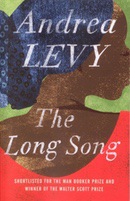
The events of these decades are the subject of Andrea Levy’s fifth and final novel, The Long Song. Born in the UK of Jamaican parents (her father came to Britain on the Windrush), Levy published only six books – her last was a book of short stories. She achieved proper recognition with her fourth, the Orange Prize-winning 2004 novel Small Island, which told the story of Jamaicans in London in the 1940s.
The Long Song, published six years later, is set in a fictional Jamaican sugar plantation called Amity. The narrator is July, born into slavery, the daughter of Kitty, a cane-cutter, and Tam Dewar, the plantation overseer. Under Dewar, life is especially harsh for the slaves, in contrast to the wealth, comforts and privileged lifestyle of the owners and their families. Rape of the black women slaves by the white ‘masters’ is by no means unusual. Mulatto (mixed-race) children of these crimes are generally given to augment the pool of unpaid and oppressed labour. Such is July’s fate.
When Amity’s owner, John Howarth, is killed, the estate is inherited by Caroline Mortimer, his sister, a widow recently arrived from England. Caroline has no understanding of the island and its ways, especially of the black population. She wants a ‘lady’s maid’. Thus, as a young child, July is taken from her mother and given to Caroline to train as a house servant.
‘ “No big black nigger gonna get past me, missus,” July said, holding up her fists so her missus might see those two fearful weapons – that were, alas, no bigger than ripe plums.’
The violence and killing of the ten-week Christmas Rebellion sees July as a young woman, a participant as well as a spectator in historical events. Then, with the passing of the 1833 Act, hopes of the slaves of Amity are renewed but quickly turn to despair and rage. The white European owners are compensated for supposed financial loss, while the black slaves have nowhere to go. They have no money and no property. Some take their meagre possessions and run away. However, the only option for many, perhaps most, is to continue work in the cane fields, if they are to eat and feed their children.
‘Then the overseer pointed his pistol at the man’s head and …. boom! Sarah said that the negro’s face simply exploded – that it burst in fragments on to the air and soon, like a bloody rain, started to gently pitter-patter down’
,July is not an innocent, having already given birth to a boy whom she leaves on the Baptist minister’s doorstep. However, she is still a young, attractive woman when Caroline hires a new overseer for Amity. Robert Goodwin is the son of an English clergyman and seems at first sympathetic to the black workers’ plight. It is all a front for his hypocrisy. Robert takes a fancy to July but will not give in to his lust because his father would not approve. But if he were married to Caroline and became owner of the plantation ……
‘It was now July’s turn to feel all her breath leave her. For this white man thought her beautiful. This white man thought her good. She lunged at him to catch him about the shoulders …. but he pushed her off so fiercely that she nearly fell.’
There is no law – and no Christian morality apparently – preventing him keeping an ex-slave mistress in a furnished room immediately below his marital bedroom! And it has to be said that July, for her part, is attracted to Robert and hopes she might benefit from the affair.
Of course, history repeats itself, and July for the second time is left holding …. Well, no, she isn’t, but you’ll have to read the book to discover how it ends.
The Long Song is a brilliant novel, better even than Small Island in my view. And that was good. Andrea Levy handles its difficult themes with understanding and humour, in spite of the sinister undertones and repulsive violence. The novel gives us, especially in July and Caroline characters with whom, for all their flaws, we can empathise. It is irreverent in tone throughout and uses language which some people will no doubt find objectionable.
That, I think, is one of its strengths. The never-to-be-uttered words of 2023 were the idiom of 1835. And it is that language which gives July’s story the feel of authenticity. Such is the author’s narrative ability that we put the book down with the certainty that she has got it just right. That was the way it was, and no amount of political correctness, or apologising after two centuries, will make the slightest difference.
Slavery in the plantations, in the Americas, was an outrage, a blot on world history, but it happened, and we should have learned from it. Sadly, it seems we haven’t!
*****

