
Crossing the Lines that Divide Us
by Nick Hayes
‘The trespasser is the bogeyman of property, the personification of the threat to the cult of exclusion. By refusing to accept the rules of what Locke called “the foundation of all democracy”, the trespasser is the antithesis of natural order, a lunatic, left-wing opponent to common sense.’
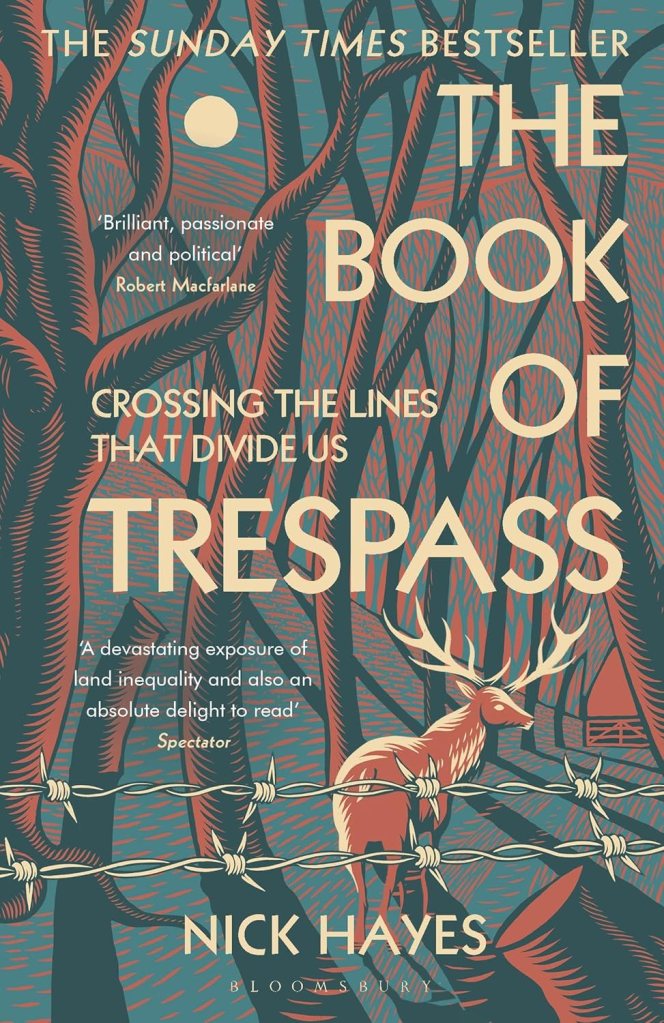
The Book of Trespass was first published in 2020 although clearly researched and possibly written – or begun – some years earlier. Part political, part historical and part ‘pastoral’, it is an intriguing study of the controversial issue of land ownership. Its subtitle could be, equally and more poetically, An Ode to the Land.
Nick Hayes, the title pages tell us, is an illustrator, print-maker and writer. To judge by the sketches reproduced in this book, he is certainly a talented artist. He has published four graphic novels. By his own admission, he is also a serial trespasser and occasional user of recreational drugs.
Described by more than one critic as ‘radical’, The Book of Trespass takes us on a journey the length and breadth of England, crossing walls, fences, ditches and waterways in support of Hayes’s theme that the private enclosure of land is not only unfair but deprives the vast majority of the population of ancient rights – to roam, explore and enjoy the countryside.
So far, I agree with him. It is unfair!
Historically too, Mr Hayes is correct. Moreover, he writes and argues well, even if he seems at times to be overfond of unnecessarily big words and crude vocabulary. [I don’t know whether the latter help his case or not.] Some of the passages describing the land he invades – though never with any malicious or destructive motivation – are really evocative and beautiful. Yet one gets the feeling at first that he has a bit of a chip on his shoulders and is preaching straight out of the Communist Party handbook: ‘All Property is Theft.’
It isn’t, and I have known ardent communists who eventually concede the point by buying themselves a house. However, as my reading progressed, I began to appreciate the writer’s sincerity and commitment to his cause. Nick Hayes is a true crusader and whether he is breaking the law or not deserves to have his ideas taken seriously by the people who make these laws. For instance, his argument for the introduction of a land value tax is especially compelling. Not in itself, because I don’t think that will solve the problem, but because it points the way to a much more iniquitous injustice which he highlights: large portions of English land are in the ownership of big corporations registered offshore. Not only that, but I doubt a land tax will work without a fundamental and simultaneous overhaul of taxation law and policy.
Some of the place Hayes ‘visits’ are well known to me, others not so. And here we come to the crux of the matter. Rights come with responsibilities! In the estates I know (including state-owned) the owners (for the most part) manage the land responsibly, with farming, forestry and care for the environment. I have to admit I am less than happy with some of their policing methods! By the way, I include Scotland in my assessment. Having grown up there, I am well aware that Scots law has always taken (and continues to take) a more benign view of trespass than England, and I was very pleased to find Mr Hayes acknowledging that. Several other European countries have similar legislation in place.
One negative is that the author has omitted or glossed over what I think are important statistics to bear in mind. According to figures I have, in the UK *** as a whole, by far the biggest landowner is the State, comprising the Forestry Commission, the Ministry of Defence, DEFRA and the Crown Estate. (over 3M acres) Large tracts of land are owned by water companies (some foreign) which in my opinion – and that of many others in the centre of politics – should never have been privatised in the first place! Excluding those, fairly near the top of the list are three charities, the National Trust, the NT for Scotland and the RSPB. (around 1M acres)
‘ “Family values”is the internalised code of nationalism, the matrix that defines the right and the wrong sort of person within the borders. It is the philosophy of the in-group, the tight ties that give rights to the select few over those of the many.’ [Please discuss!]
But wealth too comes with responsibilties, and I am far from convinced that the majority of the really wealthy actually care. I wonder rather cynically how often the Church of England, with its some 105,000 acres (I’m told) of landed property, thinks about it. If anyone should think about it, it ought to be the C of E!
The Book of Trespass is an interesting and absorbing read. While I do not entirely agree with Nick Hayes’s thesis, there is much in it which has caused me to stop and think. And that’s what good non-fiction is about. For anyone with an interest in the subject, the paperback is a good buy at around £10.
Note *** Figures from 2019 – Mr Hayes is writing mostly about England. It isn’t always so easy to split up the ownership by individual country.
***
 Magda Green Books
A well written review, the book sounds like it would be an interesting read.
LikeLike
Thank you, Diana! I confess, I didn’t know what to make of it when I started reading, but it grew on me as I got into it.
LikeLiked by 1 person
😀
LikeLike