The Book of Dust
by Philip Pullman
A Review
Thirty years have passed since Philip Pullman thrilled a generation of teenagers – and many adults too – with Northern Lights, the first volume of his trilogy, His Dark Materials. Readers of the latter will recall that the story resolved satisfactorily at the end of the third book, The Amber Spyglass. It may not have been the ending many wanted, but there was a certain logic to it, one that left open the possibility of a sequel. What would happen to the main protagonists, Lyra and Will, when they grew up?
We waited a long time for Pullman to return to his fractured (now mended?) multiverse. Now, with the publication of La Belle Sauvage, the first book of his new trilogy, the question was, could he maintain the pace and excitement of the original? Or has everything been said that can be said about Lyra’s Oxford and its place in the multiverse?
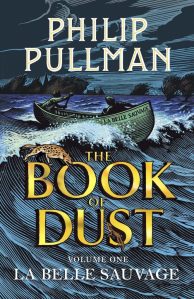
With the appearance of the new novel in 2017, the big surprise (though heralded in various media) was that Pullman went back in time rather than forward. La Belle Sauvage (which is incidentally a canoe) is a prequel set about ten years before the events described in Northern Lights.
Lyra is an eight-month-old baby, being cared for by a group of nuns in a priory by the River Thames. Already she is being sought by agents of the Magisterium, who want to kill her to prevent fulfilment of a witches’ prophecy. She is also in danger from an unsavoury physicist-turned-sexual predator, Gerard Bonneville and his three-legged hyena daemon.
‘Lyra was beside herself with glee. Nothing in the world …. had pleased her more than this crazy plunge down a waterfall in the total darkness.’
However, here we have a new hero! He is Malcolm Polstead, the eleven-year-old son of the landlord of the Trout Inn, a pub on the river, and owner of the canoe. Malcolm helps out with the customers and he hears and sees things. Befriended by Hanna Relf, a professor at the university and an expert on the alethiometer [you’ll remember, this is an instrument which can read the future], he is recruited as a spy for Oakley Street, a secret network opposed to the Magisterium.
‘Malcolm supposed the prohibition against touching another person’s daemon was true for babies as well; in any case, he would never have dreamed, after those few minutes, of doing anything to upset that little child. He was her servant for life.’
Oxford is struck by a deluge of Noah’s Flood proportions which engulfs the city and destroys the priory. Malcolm rescues Lyra with the help of Alice, the Polsteads’ teenage servant, and they embark in the little boat into the fast-moving waters. They have a choice to make: take the child to scholastic sanctuary at Jordan College, or travel to London and give Lyra into the care of her father, Lord Asriel. The choice is made for them; the current is so fierce that it drives them south towards the capital.
Pursued by Bonneville and by agents of the CCD, the Magisterium’s Consistorial Court of Discipline, Malcolm and Alice head for Chelsea. Adventure after adventure overtakes them as they try to evade their pursuers and, at the same time, take care of Lyra’s needs. They encounter, fairies, a giant and other inhabitants of the imaginery world beyond the senses. Time is running out because Asriel is preparing to depart on an expedition to the North.
‘Alice was groping for the wall and trying to stand up. Suddenly she was hurled aside as the man Bonneville burst in – smashing the door open even against the water at its foot. – and, seeing Malcolm, leaped towards him, snarling so vilely that he sounded worse than his daemon. ‘
La Belle Sauvage has little in the way of original fantasy. The ideas of His Dark Materials and some of its characters still fill the pages. The scientists are studying ‘Dust’, the philosophers probing the mysteries of the alethiometer. Mrs Coulter does not appear in the novel but her affair with Asriel is no secret and, apparently, everyone knows the baby is hers. There is talk of witches and night-ghasts. The friendly adults are suitably scholarly, the antagonists suitably evil. Bonneville is in a class of his own.
However, despite the apparent shortage of new ideas, La Belle Sauvage makes an exciting spy thriller, with kidnapping, murder, theft and secret messages as part of its intriguing plot. It stays true to the world of the original story and I very much enjoyed returning to this fascinating alternative to the countryside I know so well.
***
In November 2019, with many other fans of His Dark Materials, I sat down to watch the BBC’s dramatisation of that work. [The Secret Commonwealth had recently been published in hardback and I had already purchased a copy and begun to read it.] At lunchtime on the day following the release of the serial, I discussed it with a friend. Of course, it was too early to judge the TV production as a whole. However, we agreed that, whatever the first episode’s merits for us, it must have been difficult getting into the story for anyone who hadn’t read the books.
Moreover, the production suffered in other ways. There is a lot of ‘darkness’, even when it isn’t needed to carry the scene. At times, the dialogue is muffled and nearly inaudible. (I find this increasingly true of TV drama.)
Having watched the second and third episodes, my opinion hadn’t changed. I was enjoying the show; apart from the above-mentioned weaknesses, I think it’s great for fans of the trilogy, and far superior to the terrible movie (The Golden Compass) of a few years ago. Yet it’s hard work for anyone new to the story. My wife, who hadn’t read the books, wondered about all sorts of things. ‘Why is Lyra’s daemon a butterfly; it was a stoat a moment ago?‘ ‘Why is Mrs Coulter kidnapping the children?’ And Boreal is a real puzzle; he had me going for a few moments, slipping between Lyra’s Oxford and ‘ours’. Surely that comes into the second book, The Subtle Knife?
Six years down the road, having watched the three series through twice, I have changed my opinion to some extent. I haven’t exactly got used to the darkness or the rapid fire dialogue, but I recognise the drama for what it is, a brilliant recapturing of Pullman’s vision. While deviating from the books’ plot in places, the production modified an amplified the story in ways that only visual media can do.
I’m glad Philip Pullman published La Belle Sauvage. It works perfectly as a standalone novel and he might have given it to us a lot sooner!
***
 My thoughts on
  Magda Green Books