by Karin Smirnoff
‘His route takes him along an animal path. Birch, alder andwillow have already lost their leaves. He grabs a handful of lingonberries and pulls a bittersweet face. Bittersweet also describes the smell of the lumps of meat left in the lidded plastic drum.’
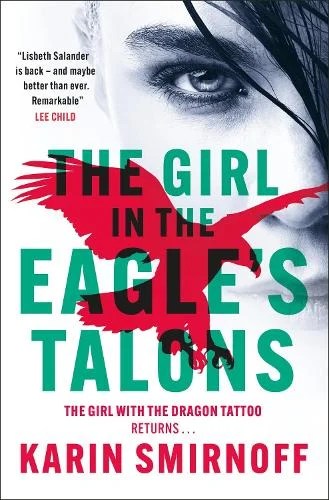
It is nearly twenty-five years since Lisbeth Salander burst forth on the literary scene in a blast of originality. At first a Swedish phenomenon – although dark Swedish thrillers were not exactly new – Stieg Larsson’s unlikely fictional heroine gained a worldwide following through translations into English of his three novels and a series of movies featuring actress Noomi Rapace in the role.
Sadly, Larsson did not live to see the success of his creation. In fact, all three of the Millennium Series novels were published after his death in 2004. However, his legacy has lived on. Lisbeth survived and her adventures continued in a second trilogy written by David Lagercrantz and published between 2015 and 2019.
Now, the literary baton has been taken up by a third novelist – Karin Smirnoff – in The Girl in the Eagle’s Talons (2022), which came out in English translation this year. Perhaps Lisbeth ought to be too old now (and maybe wiser) to indulge in derring-do escapades, but she clearly isn’t. Arriving in the far north of Sweden to take (temporary, she hopes) responsibility for a niece, Svala, child of her dead half-brother Niedermann, she is immediately embroiled in adventures involving the Sami people, windmills, corrupt officials and murderous villains.
‘One-armed rag doll Svala Hirak makes full use of centrifugal force …. Pap Peder’s final trip to the sun takes him in a wide arc, over the glass barrier that runs around the edge of the netting. A hundred-kilo body falling ten metres does not scream. It lands obligingly on a rock and breaks its neck.’
Mikael Blomkvist too (fans of Millennium will know who he is) has come to Nordland. His daughter Pernilla is to marry council leader Henry Salo, whose plan to divide the land for development into three is threatened by Marcus Branco, a wheelchair-bound ‘business man’. Branco, head of a criminal empire involving extortion, kidnapping, abuse and rape of young women, and murder, wants the windfarm project (as well as some associated mining interests) all to himself, and is quite prepared to ‘remove’ anyone who stands in his way, be they man, woman or child (and including Lukas, Mikael’s young grandson), Sami or otherwise.
‘Mikael Blomkvist does not think. He runs towards the exit, towards Lukas, towards the voice that keeps on yelling for him. He can hear the boy. Faster, you can make it, get the boy back, run like hell Blomkvist, run.’
The Girl in the Eagle’s Talons features character both old and new. Among the former, apart from Salander and Blomkvist, are Sonny Nieminnen and his gang of bikers, also in the North for what they can make out of drugs etc. The latter includes Svala, and her mother Märta Hirak. The Hiraks are a Sami family whom Branco wants OUT.
Svala (aged 13) is something else entirely, a sort of Lisbeth-in-the-making. Bits of the Zala/Niedermann DNA are in her too. She has Camilla’s (Lisbeth’s dead twin) beauty, Niedermann’s insensitivity to pain, can open safes, do Rubik’s cube, and is not bad with numbers either. Artistic too, and with Lisbeth’s careless courage into the bargain, she makes a delightful character.
I suppose the plot is predictable, with Nordland snow, chases through wild Swedish forests, a grotesque antagonist, guns and improbable contests, and the inevitable sex and violence. The Girl in the Eagle’s Talons has the makings of a great story, indeed it IS a geat story, principally for the strong (if improbable) characters rather than for the plotting, which I found awkward.
The book does not have the literary flow of the Larsson stories. I thought the writing fragmented rather than continuous, with too many interruptions for ‘in-the-head’ back story. That may have been the translation, although I suspect it was due to Smirnoff’s style, quite different from that of her predecessors. Nevertheless, there was some excellent dramatic writing, some of it quite stomach-turning. And the negatives will not stop me reading the next two she is contracted to write!
Last word to Svala:
‘Sorry, Aunt Lisbeth, but this is my Mammamärta we’re talking about. I’m not going to sit here waiting like an innocent child. And you didn’t expect me too either.’
***
 Magda Green Books