
by Margaret Atwood
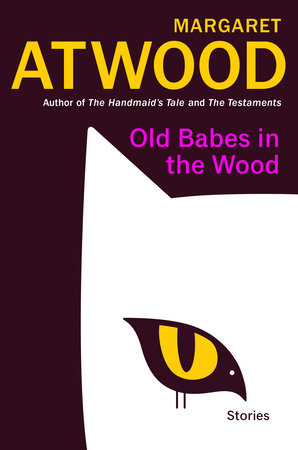
What more can be said of Margaret Atwood, more than has been said already by countless readers? Novelist, poet, essayist, children’s writer, it seems she has been around for a very long time. She has; her first book was published in 1961. And can she go on churning out these wonderful, inspirational, sometimes dystopian, and often zany stories? One hopes she can, at least for some time yet.
‘ “I thought you might want to …. you might want to bury him yourself, in the backyard,” Lizzie sobbed …. “so I wrapped him in a piee of red silk brocade and, and, I put him in the freezer.” ‘ [from Morte de Smudgie]
Old Babes in the Wood is a collection of themed short stories on the subject of age and getting older. Some would say ‘old age’, but whereas ‘getting older’ is an inevitable fact of science, ‘old’ is a state of mind. These sparkling, topical, funny and irreverent tales follow an elderly couple, Tig and Nell, through their declining years. Part Three, significantly, is entitled Nell and Tig, while the last story takes the book’s title.
‘Curled within the shell of the human woman’ skull where our two souls were space-sharing, I found myself muttering, “Why are you whining? At least no one sprayed you with snail pesticide.” ‘ [from Metempsychosis]
The journey of Old Babes in the Wood matters as much as the beginning and end. There are few subjects which Atwood won’t tackle, be it politics, religion, dementia or death, and each has its place here. Nor does she shrink from the use of what the previous generation (and many in Ms Atwood’s and mine) would call naughty language. The first death we encounter is that of a cat in the story Morte de Smudgie. Nell’s tribute is to rewrite the whole of Tennyson’s Morte d’Arthur with Smudgie as the hero and cats as the supporting characters.
‘Fuck used to be unprintable, whereas racial and ethnic slurs were common, but now that has flipped. Myrna takes note of all such verbal mutations …. she once published a paper on it in Maledicta: The International Journal of Verbal Agression. “Fuck You, and Good Fuck – Negative and Positive Values for a Problematic Word.” ‘ [from Airborne]
In another tale, The Dead Interview, the author interviews George Orwell as a manifestation of a medium’s trance. In Death by Clamshell, she reimagines the final hours of Hypatia of Alexandria from the point of view of the mathematician herself. In Metempsychosis (or The Journey of the Soul), the reader may choose whether to believe in reincarnation, or that the narrator is, what, ‘nuttier than a fruitcake’. Then there is the philosophy of widowhood in Widows and nostalgia in The Wooden Box.
And that’s only half. The other stories – allowing a few pluses and minuses for personal taste – are equally readable, all fine examples of Margaret Atwood’s craft, her unrelenting satire and judicious – or is it injudicious? – use of the F word! Elsewhere, we get an old soldier, an alien, and a witch.
‘In addition to [the] statues there have been several paintings of a quasi-pornographic variety …. What interested these painters was evidently the fact that my clothes were torn off, which allowed them to paint a naked woman in distress, always of interest to a certain kind of man.’ [from Death by Clamshell]
Margaret Atwood has won the Booker Prize twice and has been awarded countless other prizes and honours, for novels, poetry and non-fiction. Old Babes in the Wood contains some of her most entertaining work.
‘Oh great, thinks Nell. I have an imaginary friend who’s a dead person. In this she is not the first.’ [from Wooden Box]
****
 Magda Green Books